
A Plush Toy's Passport: What It Actually Takes to Get a Custom Doll Onto a Tokyo Shelf in 2026
Pick up almost any doll from the sample shelf in our Dongguan workshop and you can trace a line backward: a fabric mill in Zhejiang, a vinyl face mold cut last winter, a pattern maker who redrew one ear four times. Trace it forward and the line runs through a testing lab, a Korean importer's address on a label, a booking window that closed three weeks before the carton was ready.
Somewhere along that line, the doll acquires a passport — an origin, a face, a test report, a language it has to speak, a country it is allowed to enter.
Most sourcing conversations start with unit price. This one starts with the document trail, because in 2026 the document trail is often what decides whether your doll ships at all. Below is that journey, station by station, with the numbers we actually work to.
Station 1: The fabric decides half the paperwork before anyone asks about price
The first decision on a custom plush order is not the design. It is what the thing is made of, because material choice locks in chemical testing, cost, and hand-feel all at once.
In 2026 the request we hear most from Japanese and Korean buyers is short-pile minky for the body and recycled polyester (rPET) where the brand has an ESG line to defend. Both are fine. Neither is free: rPET supply has been tight enough that quotes move between the sampling stage and the bulk order, so we quote material with a validity window rather than an open number.
Filling is where first-time Korea shippers get caught. Korean rules require a microbial test on the stuffing — a test that has no direct equivalent in the EN 71 conversation most European-facing factories are used to. If your factory has never shipped to Korea, it will not have this in its standard test package, and you will find out at the wrong end of the schedule.
Practical note: decide fabric and filling at the artwork stage, not after the sample. Changing filling after sampling means re-testing, and re-testing means your ST or KC paperwork restarts.
Station 2: The face is the passport photograph
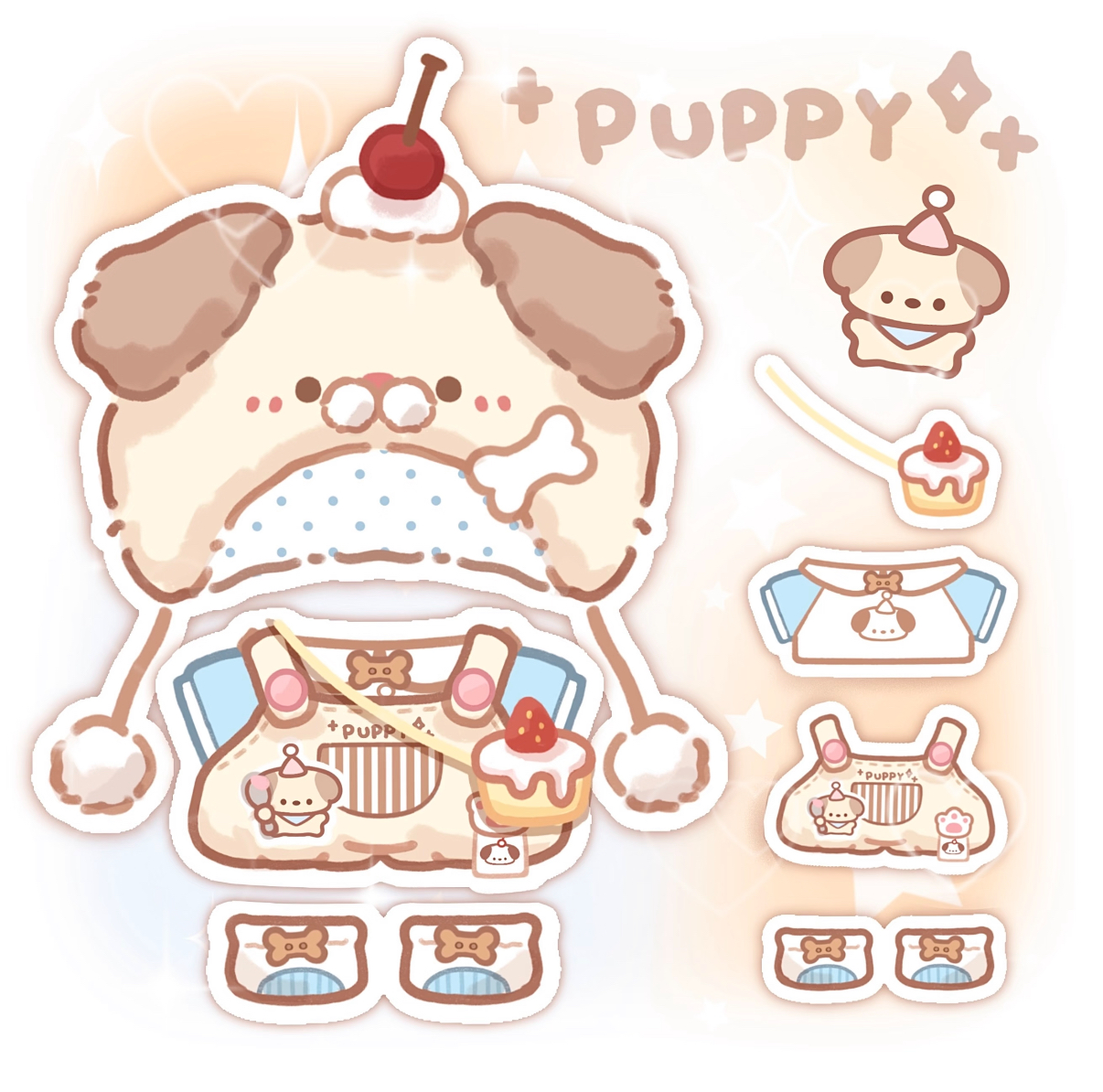
Here is where traditional plush and vinyl-face dolls (the "胶脸" construction common in Japanese and Korean character goods) part company.
An embroidered face is forgiving. A stitch shifted by a millimetre is a millimetre nobody notices. A vinyl face is not forgiving at all. The plate has to be molded to the character's exact expression, colour-matched to a Pantone reference under the lighting your client will photograph it in, and set so that the plush seam disappears cleanly underneath it. A one-millimetre misalignment on a 12 cm doll reads as a crooked face in every product photo the buyer will ever take.
Two things go wrong on vinyl faces, over and over:
Gloss. The reference art was flat. The molded plate arrives glossy and the character suddenly looks like a cheap keychain. Matte, satin and soft-touch finishes photograph completely differently, and the choice has to be made on a physical sample, not in an email.
The joint. The face plate is the single point where a pull test, a torque test and a small-parts assessment all converge. It is also the part a buyer's QC will attack first. If your supplier treats the plate as a decoration rather than a structural component, the doll fails at the testing stage, not the review stage.
We build both constructions, which is why we ask for the character's mouth-open/closed state, the intended viewing distance (a 14 cm mascot is photographed at 20 cm; a 45 cm plush at a metre), and the lighting the client shoots in before we cut a mold.
Station 3: Seven to ten days, and why that number is a business decision
Our first prototype takes 7–10 working days for a standard design and 10–15 for a complex licensed character. A revision round takes 3–5 days. Sampling starts at ¥500 including pattern work, up to three free revisions and one final prototype.
Those numbers are only meaningful because the whole chain sits in one building. Designers, pattern makers, hand-sewers and a pre-production QC reviewer are on the same floor as the production line that will eventually run the order. No sample goes out to a third-party workshop and comes back with an interpretation of your character that nobody can explain.
Why this matters more in 2026 than it did in 2020:
Japan's character economy has moved from "goods attached to a property" to "a relationship you carry around." 推し活 (oshi-katsu) became a household phrase; ぬい活 (nuikatsu) — taking a plush out into the world, dressing it, photographing it — went from a niche hobby to a buzzword in 2025 and kept widening through 2026. The trade show calendar reflects it: 推し活EXPO ran at Tokyo Big Sight in June and again in October 2026, and the halls were full of plush, doll clothes, carry pouches and photo sets, not just acrylic stands.
A trend like that has a brutal calendar. A pop-up tied to an anime season, a collaboration with a game update, a limited pre-order window: none of them can absorb a six-week sampling loop. Sampling speed is not a service detail. It is the difference between being able to say yes to a trend and watching someone else take it.
Station 4: The border, where the doll gets its papers

This is the part buyers underestimate, and the part that separates a factory that ships to Japan and Korea from one that has shipped there once.
Japan: two systems, and you need both
Japan runs a mandatory track and a voluntary one, and most first-time exporters only prepare for one of them.
The Food Sanitation Law (食品衛生法) is mandatory. Toys intended for infants, or any part likely to enter a mouth, fall under the toy provisions of the food apparatus and container standards, supervised by the Ministry of Health, Labour and Welfare. Importers file an import notification with the quarantine station and the material has to pass migration testing that simulates saliva, water, acid and oil. There is no way around this one.
The ST Mark (ST-2016) is technically voluntary, and effectively not. Part 1 covers mechanical and physical safety, Part 2 flammability (the plush cap sits at a 30 mm/s burn rate), Part 3 chemicals — eight heavy metals plus formaldehyde and six phthalates. Major Japanese retailers will not list a toy without it. Our clients get asked for the ST report by the buyer's compliance team before they get asked about the carton price.
Korea: the mark has to be printed on the doll
Korea's Children's Product Safety Special Act, administered by KATS, sends most plush toys down the safety-confirmation route — lab testing at a KATS-recognised body, no factory audit, certificate reported valid for five years. The test standard is KS Q ISO 8124, which mirrors ISO 8124 closely enough that your EN 71 or ASTM file is useful reference, but not a substitute: it has to be converted, not translated.
Four details decide whether a Korean shipment clears:
The KC mark must be permanently printed on the product itself, not stuck on the carton. A sticker on the box is a fail.
The label is in Korean, with product name, age grading, material composition, country of origin, and the Korean importer's name, address and contact.
An overseas factory cannot be the applicant. You need a Korean importer or authorised representative to hold the certificate. This is a commercial relationship question before it is a technical one.
PFAS limits on infant and kids' products have been tightening through 2026. If your fabric supplier changed a water-repellent finish this year, assume it needs re-checking.
A useful contrast for anyone also selling into the US: in America the 2026 conversation is tariff lines — IEEPA duties struck down in February, a 10% Section 122 surcharge after it, a new Section 301 forced-labour tier from late July. In Japan and Korea there is no tariff drama. There is only the paperwork, and the paperwork does not negotiate.
Station 5: Five hundred pieces, and the only reference that counts
Once the sample is approved, that physical unit becomes the reference for the entire run. Not the artwork file. Not the photo in the tech pack. The doll on the table.
Before cartons are sealed, every finished piece is compared against it on five points: size, face placement, seams fully closed, stuffing amount and silhouette, and the details the buyer signed off on — accessory position, label placement, colourway. A piece with an eye sitting lower than the reference gets pulled and corrected. It does not get packed with a note.
Stage | Working time |
Artwork review and sampling quote | within 24 hours |
First prototype | 7–10 working days (10–15 for complex IP characters) |
Revision round | 3–5 working days |
Bulk production | 30–60 days, depending on quantity and complexity |
MOQ | 500 pcs per design (300 for simpler designs) |
Terms | EXW Dongguan, 50% deposit, balance before shipment |
If you want your own inspector involved, say so at the quotation stage — not after the goods are packed. It gets scheduled into the run, and our side provides the approved prototype as the reference unit.
What the passport doesn't show
A doll leaving Dongguan for Osaka carries a label, a test report and a declared origin. What it also carries, invisibly, is a set of assumptions about who will hold it.
In Japan and Korea right now, that person is very often not a child. They are an adult with a photocard in their wallet and a small doll in their bag, who will photograph it in a café and post it before they finish their coffee. They judge the face, not the stitch count. They judge the third angle, not the first. They will buy a second one if the first one survived being carried around for six months.
Which loops back to the vinyl face, the matte finish, the 7–10 day prototype, the 3 mm of stuffing that decides whether the doll sits upright in a bag. None of it is glamorous. All of it is what the passport is actually made of.
If you are bringing a character to Japan or Korea in 2027, send us the artwork and the target market. We will come back within 24 hours with a feasibility read, a sampling quote, and an honest note on which tests your line will need — before you commit to a mold.
FAQ
How long does a custom plush sample take, and can it be faster?7–10 working days for a standard design, 10–15 for complex licensed characters, with 3–5 days per revision round. Timing starts when we have artwork and material direction, not when the enquiry lands. Rush sampling is possible when the pattern can be simplified without changing the character's read.
Do I need the ST Mark to sell plush in Japan?Legally, no — the Food Sanitation Law is the mandatory requirement. Commercially, yes: major Japanese retailers and e-commerce platforms will not list a toy without it. Budget 4–8 weeks for testing, and plan it alongside production rather than after it.
Can the same production run be certified for both Japan and Korea?Usually yes, if the materials and construction are fixed before sampling. The two schemes test overlapping but not identical things — Korea's filler microbial test and its requirement to print the KC mark on the product body are the two that most often force a change late. Decide the market before the sample, not after.
Product Information
Product name
Size(cm)*
Quantity(pcs)*
Contact*
Other requirements
Sample image*
Note:Up to 3 files, each within 500MYour artwork is used only to evaluate and sample your project. We do not publish it or share it with third parties.



COPYRIGHT © Guaila Toys ALL RIGHTS RESERVED