
Sourcing Plush Toys in 2026: What We'd Tell You Before You Send a Single Email
By the team at Guaila Toys (乖啦玩具) — a factory-direct plush manufacturer in Dongguan
If you're reading this, you're probably about to source custom plush toys — or you've already started and it's going worse than you expected. Either way, good. This is the conversation we have every week with brand owners, importers and retail buyers, and it's the one most suppliers won't put in writing.
We'll skip the fluff. Here's what actually changed in 2026, what it means for your order, and the questions you should be asking before you send artwork to any factory — including us.
First, the honest part: the market didn't get easier. It got more specific.
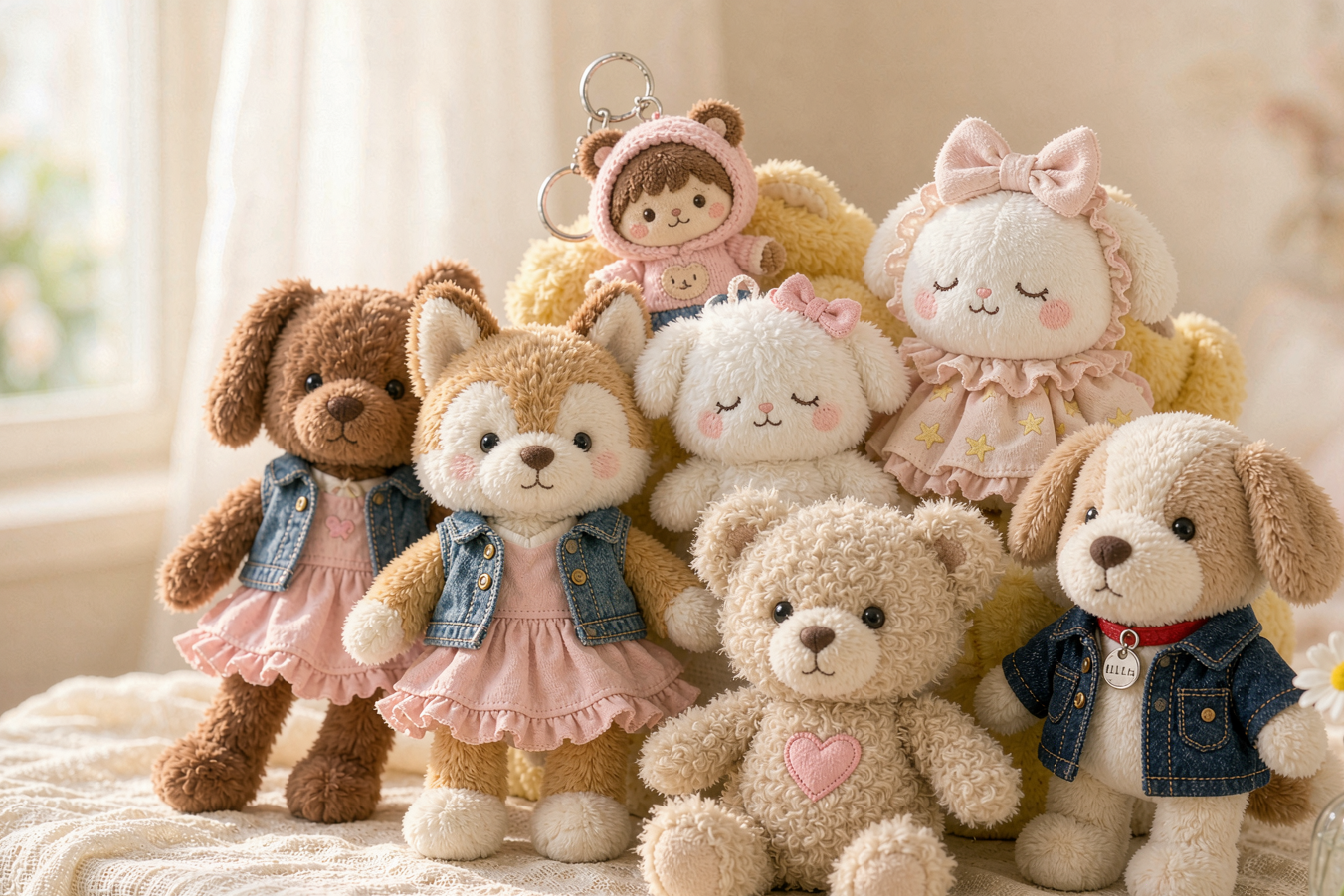
A lot of people still think of plush toys as a stable, low-complexity category. That was true in 2020. It's not true now.
The global plush market is still growing — roughly USD 68–110 billion in 2026, up about 4.7% year on year — but the growth isn't coming from "more toys for kids." It's coming from adults. Across the industry, the 25–40 age group now drives more than 40% of the incremental demand, and the fastest-growing segments aren't teddy bears. They're IP character goods, "healing" comfort plush, and the kind of small, photographable dolls that people carry in their bags and post online.
What does that mean for you, the buyer? Two things.
One: the rules have changed on what "good" looks like. A few years ago a buyer's checklist was unit price, lead time and "does it look like the artwork." In 2026 the checklist that actually matters is compliance first, then construction quality, then price. A factory that can't document its compliance — or that treats a vinyl face plate as decoration rather than a structural part — will fail your QC before you ever argue about cost.
Two: the opportunity has moved. The buyers we see doing well this year aren't chasing the biggest order. They're chasing the right order for the right market, and they're building it around compliance and speed rather than price alone.
The Japan and Korea opportunity is real — and it's gated by paperwork, not price
If you're selling to the US or Europe, you've lived through the tariff cycle of the last two years. In Japan and Korea, there's no tariff drama. What there is, instead, is a document trail that decides whether your doll ships at all.
Here's the part most first-time exporters get wrong: Japan runs two systems, and you need both.
The Food Sanitation Law (食品衛生法) is mandatory. If the toy is for infants, or any part could go in a mouth, the material has to pass migration testing that simulates saliva, water, acid and oil. There's no workaround.
The ST Mark (ST-2016) is technically voluntary — and commercially, it isn't. Part 1 covers mechanical safety, Part 2 flammability, Part 3 chemicals (eight heavy metals, formaldehyde, six phthalates). Major Japanese retailers simply won't list a toy without it. Our clients get asked for the ST report by the buyer's compliance team before they get asked about the carton price.
Korea is a different trap for the unwary. The KC mark must be printed on the product itself — a sticker on the box is a fail. The label has to be in Korean, with age grading, material composition, country of origin, and the Korean importer's name and address. And an overseas factory cannot be the applicant: you need a Korean importer or authorised representative to hold the certificate. Add to that the microbial test Korea requires on stuffing — a test with no direct equivalent in the EN 71 world most European-facing factories know — and you can see why "we've shipped to Europe" is not the same as "we can ship to Seoul."
The payoff, though, is worth it. Japan's nuikatsu (ぬい活) culture — taking a plush out into the world, dressing it, photographing it — went from a niche hobby to a buzzword through 2025 and 2026, and it's still widening. The nuikatsu market hit roughly ¥84.9 billion in 2025, about 1.7x where it was in 2021, and it's driven by oshikatsu (推し活) fan culture that isn't limited to kids. These buyers judge the face, the third angle in a photo, whether the doll still looks good after six months of being carried around. That's a quality conversation, not a price conversation — and it's exactly the kind of order a compliance-serious factory can win.
The US is coming back — but the tariff window doesn't forgive sloppy timing
The other big 2026 shift is on the US side. After the reciprocal tariff framework was settled in late 2025, most toy categories returned to MFN rates. That's a real tailwind: we've seen US-bound orders flow back to the manufacturing clusters in Chenghai, Dongguan and Yangzhou, and Dongguan alone exported ¥19.54 billion of toys and designer toys in the first nine months of 2026, up 11.5% year on year.
The catch is timing. The 2026 Christmas peak has been longer than usual, and by late October most serious factories had already booked production through Q1 2027. If you're planning a seasonal launch, you work backwards from the ship date — not from the date you finally get around to approving samples. This is where sampling speed stops being a nice-to-have and becomes the difference between hitting your window and watching it close.
Compliance is no longer the last step. It's the first filter.
This is the single biggest change we see in 2026, and it applies to every market, not just Japan and Korea.
Two things happened. First, China's new mandatory standard GB 6675-2025 took effect on November 1, 2026 — tightening limits on formaldehyde, TVOC, chlorinated paraffins and boron, and aligning Chinese manufacturing with EU and North American requirements. Second, the attitude of overseas buyers changed. CPC certification for the US went from "nice to have" to a hard gate. European buyers are scrutinising EN 71 more aggressively. And a growing number of large retailers and cross-border e-commerce sellers now won't even put you on their shortlist unless you hold ISO 9001 quality management and a BSCI social compliance audit.
In other words, certification is no longer a paper you can rush at the end of a deal. It's the first screen that decides whether you get a seat at the table. When you're evaluating suppliers, ask for the certificates up front — and treat a supplier who's evasive about them as a red flag, not a detail to sort out later.
What we'd tell you to ask — before you send artwork to anyone
We write this for our own customers because the questions below save both sides weeks of rework. But they're worth asking any factory.
1. "How do you count MOQ — per design, or per order?"This is the question that separates an honest factory from one that's going to surprise you later. Fabric is cut per design, embroidery files are made per design, a production line is set up per design. Splitting 500 pieces across five characters is not one run of 500 — it's five runs of 100, each carrying the full setup cost. A factory that happily splits your quantity is usually splitting something else as well. (For reference: our export MOQ is 500 pieces per design, 300 for simpler designs, and 100 for cotton dolls — the exception, because they're a genuinely smaller construction.)
2. "What does the sample fee actually buy?"Sample fees should be assessed from your artwork, not quoted in the abstract — and you should know exactly what you're getting: how many revision rounds, how many final prototypes, and whether the fee is credited against bulk. A vague answer here is a preview of a vague project.
3. "Which market am I building for — and have you shipped there before?"Decide the market before the sample, not after. Japan's ST requirements and Korea's KC mark and filler microbial test don't map one-to-one onto an EN 71 file. If you change the target market after sampling, you may be re-testing — and your paperwork restarts.
4. "Where does the face come from?"If you're doing vinyl-face dolls (the 胶脸 construction common in Japanese and Korean character goods), this is where orders live or die. A one-millimetre misalignment on a 12cm doll reads as a crooked face in every product photo. The finish — matte, satin, gloss — has to be chosen on a physical sample, not in an email. Ask how the supplier treats the face plate: as a decoration, or as a structural component that a pull test and a torque test will attack.
5. "What's the reference for the whole production run?"The answer should be: the approved physical prototype, not the artwork file. Every finished piece should be checked against it — size, face placement, seams, stuffing, silhouette, accessory position. A factory that packs a slightly-off piece "with a note" instead of pulling it is telling you how seriously it takes your brand.
6. "When do I need to commit to fabric and filling?"The right answer is: at the artwork stage. Material choice locks in chemical testing, cost and hand-feel all at once, and changing filling after sampling means re-testing. In 2026, with rPET supply tight enough that quotes move between sampling and bulk, a factory that quotes material "with a validity window" is being honest; one that quotes an open number forever is not.
The part we don't get to skip, either
None of this is glamorous. Most of it never shows up in a product photo. A doll leaving our Dongguan workshop for Osaka carries a label, a test report, and a declared origin — but what actually gets it onto a shelf is the accumulation of small decisions: the short-pile minky, the matte finish on a vinyl face, the 3mm of stuffing that decides whether it sits upright in a bag, the 7–10 day prototype that let your client say yes to a trend while the window was still open.
That's the real job in 2026. Not making the cheapest doll. Making the one that clears customs, passes a buyer's QC, and survives being carried around for six months — in the specific market you're actually selling to.
If you're bringing a character to market and want to talk through the specifics — artwork, target market, quantity, and which tests your line will actually need — send it over. We'll come back with a feasibility read and a sampling quote, and we'll tell you straight which parts are easy and which ones will fight you. Before you commit to a mold, that's worth more than any unit price you'll be quoted this week.
Guaila Toys (乖啦玩具) is a factory-direct B2B manufacturer of custom plush toys, cotton dolls and IP merchandise, with our own Yuequan Toy Factory in Dongguan. ISO 9001:2015 certified and BSCI audited. We ship to the US, Japan, Korea and beyond.
Want to keep reading? See our MOQ & Sampling Guide and how long custom plush actually takes to make.
Product Information
Product name
Size(cm)*
Quantity(pcs)*
Contact*
Other requirements
Sample image*
Note:Up to 3 files, each within 500MYour artwork is used only to evaluate and sample your project. We do not publish it or share it with third parties.



COPYRIGHT © Guaila Toys ALL RIGHTS RESERVED