
What to Include in a Custom Plush Toy Tech Pack: Artwork Brief Checklist for OEM Factories
A custom plush tech pack is the written and visual package that tells an OEM factory what to quote, sample, and eventually cut. It is more than a character illustration. At minimum it identifies the product and version, shows clear multi-view artwork with key measurements, maps fabric and finish by body zone, states face and construction methods, notes filling and structure goals, lists accessories and labels for the target market, and names who can approve changes. Missing fields are what create email loops and paid sample revisions.
Guaila Toys works with B2B brands and retailers on custom plush OEM and ODM projects. A clear brief helps the product and sampling team respond with fewer clarification rounds, and with a sample that matches the intent of the artwork.
If you are briefing a plush keychain rather than a standard plush toy, start with the custom plush keychain design brief. The checklist below is written for regular plush programs and can still be used as a frame for smaller items.
What a plush tech pack is
In apparel, a tech pack usually means flat sketches, measurements, materials, trims, and construction notes. Soft toys need the same discipline, plus plush-specific fields: pile and hand-feel by panel, face method (embroidery, print, or safety eyes), stuffing firmness and shape retention, and label expectations for the destination market.
Factories ask for a tech pack because quoting from a single front-view JPEG forces guesswork. That guesswork shows up later as the wrong belly fabric, embroidered eyes when plastic safety eyes were intended, or a height that was sitting height rather than standing height. A complete package turns those assumptions into decisions before fabric is reserved or a sample is sewn.
1. Product identity and version control
Open the file set with a header the whole supply chain can reuse:
- Working name, SKU, or character name
- Intended use, such as retail shelf, gift-with-purchase, e-commerce exclusive, event giveaway, or licensed IP
- Target age positioning if known (this affects face method and small-part choices)
- Document version and date, for example Brief v1.2, 2026-11-12
- What changed since the last version, even in one line
If several colorways or sizes share one character, say whether this pack covers one SKU or a family. Mixing pink-only artwork with instructions for all four colorways is a common source of wrong samples.
2. Multi-view artwork and measured sizes
Give the factory more than a hero pose:
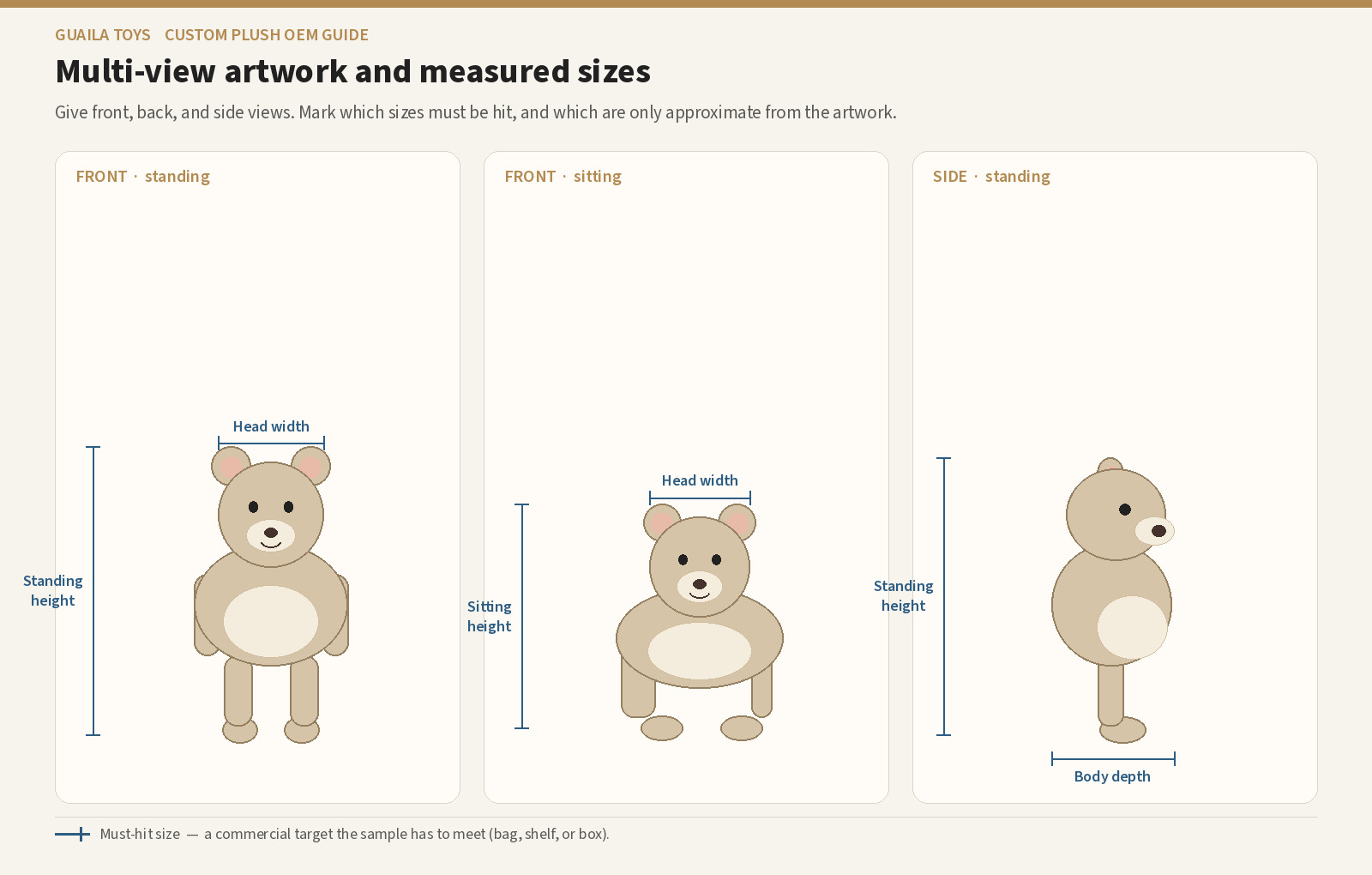
- Front, back, and side (or three-quarter) views at readable resolution
- Close-ups of the face, hands or feet, and any logo or graphic zones
- A simple panel map if panels are complex
- Key measurements: overall height (state sitting versus standing), head width, body depth or width, and any hard constraints such as a polybag, shelf height, or gift box
Mark which dimensions must be hit and which are approximate from the artwork. Plush compresses; the sampler still needs a commercial target. Prefer a clean annotated PDF or vector drawing for dimensions, plus high-resolution images for look and feel. Hand sketches work for early discussion if proportions and notes are readable.
For how size choices affect use and display, see How to Choose the Right Size for Your Custom Plush Toy. The tech pack only needs the measured targets and constraints for this SKU.
3. Fabric and hand-feel zones
Do not write “soft plush” once for the whole toy. Map materials by zone:
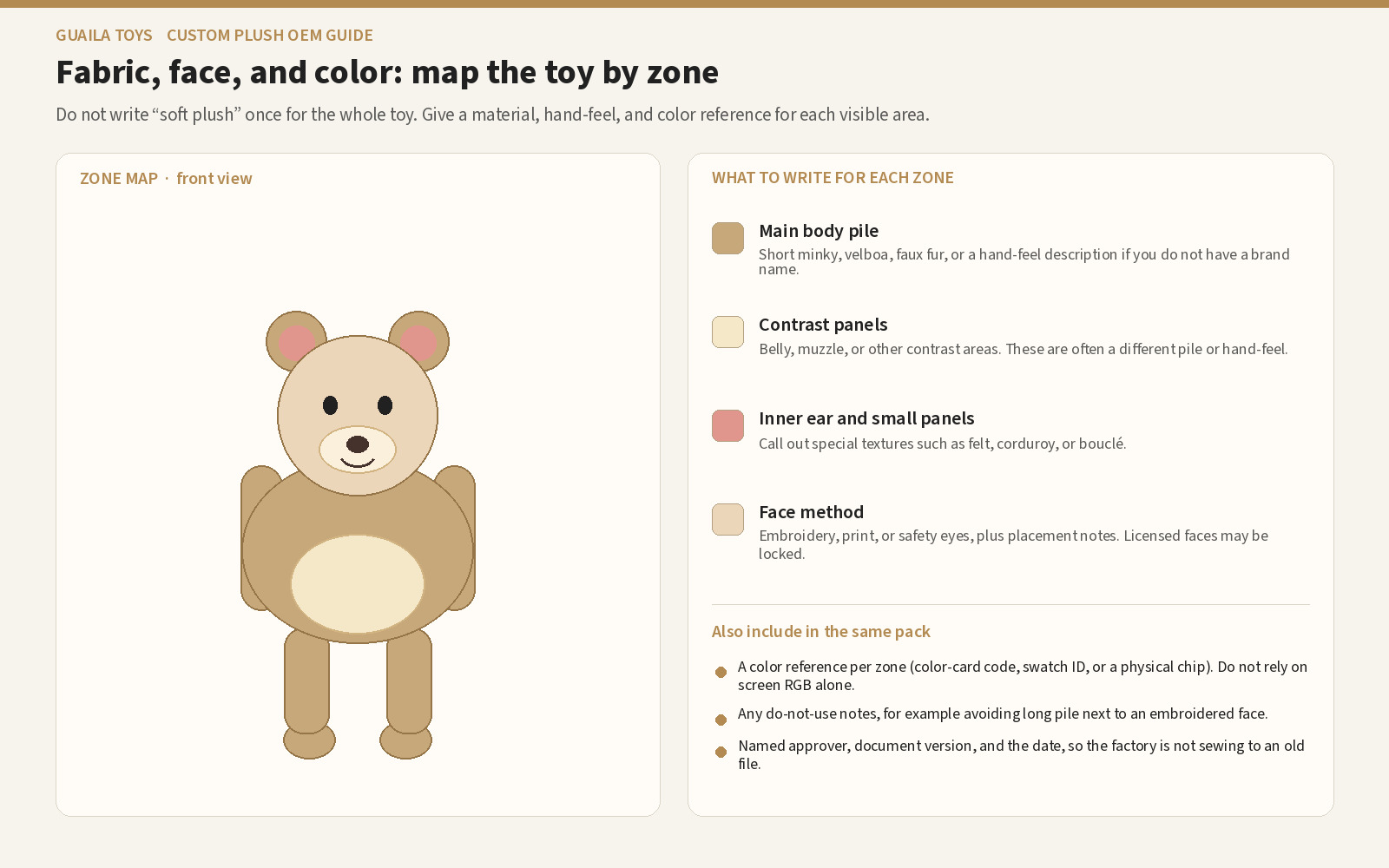
- Main body pile (short minky, velboa, faux fur, or a hand-feel description if brand names are unknown)
- Contrast panels such as belly, inner ear, or muzzle
- Special textures such as bouclé, corduroy, or felt appliqué
- Any do-not-use notes, for example avoiding long pile next to an embroidered face
If you have approved physical swatches, photograph and label them. If you only have direction, such as “closer to our past SKU,” say so. Deeper fabric choice topics sit in How to Choose Plush Fabric for Custom Plush Toys. The tech pack only needs a zone map so quoting and sampling share the same assumptions.
4. Color references
For each fabric or trim zone, give a color reference: a textile color-card code, a brand swatch ID, or a note to match an enclosed physical chip. Note which colors are brand-critical and which may use the closest stock option. Do not rely on uncalibrated screen RGB alone.
This article does not walk through dye development or lot-to-lot approval. Those are separate production controls once materials are chosen. For the tech pack stage, every visible color zone needs an explicit reference and an owner who can accept a stock alternative if needed.
5. Face details and construction methods
Face choice changes tooling, cost, and safety review. State explicitly:
- Eyes: embroidery, print or heat transfer, plastic safety eyes (size if known), or mixed
- Nose, mouth, and blush: method and relative placement
- Whether the face must match the artwork exactly, or whether the factory may suggest sew-friendly adjustments
- Hair tufts, lashes, or 3D elements that affect pattern engineering
If the character is licensed IP, note that face proportions may be locked by the licensor. The factory cannot change the expression to look “cuter” without written approval. For method trade-offs, see Embroidered, Printed, or Safety Eyes?. For the safety test reports and certificates buyers usually ask for, including on licensed programmes, see Plush Toy Safety Testing & Documents.
6. Filling, structure, and seam expectations
Tell the sampler what finished feel means:
- Soft, medium, or firm preference for hugging versus display
- Areas that must stay flat or be heavily stuffed, such as cheeks, belly, or limbs
- Internal structure only if already decided and appropriate for the market
- Seam expectations, such as clean outer seams and reinforced stress points
Shape retention after packing matters for e-commerce. Point to filling-and-seam goals in the brief so the first sample is not a guessing game.
7. Accessories and add-ons
List every non-body part: clothing, scarves, bags, charms, or stands. Include sound modules or magnets only if they are already required. State the attachment method (sewn-in or removable) and any child-safe constraints you already know. Accessories often drive separate sourcing lead times; calling them out early avoids a body sample that cannot be finished.
8. Labels, markings, and target market notes
Factories need market context even before final tag artwork:
- Destination market or markets, and channel (for example US, EU, or UK retail, Amazon, or corporate gift)
- Required on-product marks you already know, such as a care and content label, hang tag, or barcode placement
- Brand logo rules for woven or printed labels
- Licensed IP legal-line requirements if applicable
Do not invent certification claims in the brief. State what your compliance team requires, or mark “compliance package to follow.” Guaila can align sampling with the markets you name; final testing and markings follow the project’s documented requirements. Hang-tag artwork and proofing have their own checklist: Custom Plush Hang Tags.
9. Packaging direction
Even a one-paragraph note helps quoting: polybag only, gift box, window box, or header card; insert cards or moisture protection for long transit; retail versus direct-to-consumer unboxing priority. Detailed packaging options live in How to Package Custom Plush Toys for Retail, Gifts, and E-commerce. The tech pack only needs commercial direction so carton and accessory quotes are not reinvented mid-project.
10. Quantity window and timing
Include planning ranges without locking a single public minimum-order number in the brief:
- Estimated first-order quantity band, or a note that quantity will be confirmed after sample
- Whether multiple SKUs or colorways share materials
- Target sample date and target ship window if known
- Event or launch dates that cannot move
Order thresholds and sampling fees depend on style complexity, materials, and destination. Guaila confirms minimums and timelines per project after reviewing the pack. Do not treat a past quote as a universal rule. For how to plan sampling, bulk production, testing, and freight backward from a launch date, see How Long Does It Take to Make Custom Plush Toys?.
11. Approvers, change log, and file hygiene
Close the pack with process hygiene:
- Named approver or approvers for artwork, sample, and production release
- How change requests are logged (version bump, date, and what changed)
- A file naming convention, such as SKU, view, and version
- A single source of truth (one folder or one PDF set), not several chat threads with conflicting images
If legal or licensor approval is required, say so before the factory invests in a second sample round.
Minimum usable brief vs full tech pack
| Field | Minimum usable brief | Full tech pack (preferred before a paid sampling lock) |
|---|---|---|
| Identity | Name, use case, and date | SKU, version history, and colorway list |
| Artwork | Clear front view and face crop | Front, back, and side views plus detail callouts |
| Size | One overall height target | Height, key widths, and must-hit versus approximate |
| Materials | Main body and belly direction | Full zone map and do-not-use notes |
| Color | References for main colors | Per-zone references, plus critical versus flexible |
| Face | Eye and nose method chosen | Placement notes and IP lock status |
| Fill and seams | Soft, medium, or firm | Zone stuffing and stress points |
| Accessories | Listed yes or no | Specs and attachment method |
| Labels and market | Destination market | Label types, logo rules, and a compliance note |
| Pack | Bag versus box preference | Retail or e-commerce direction |
| Quantity and time | Rough band and sample wish date | Confirmed windows in the project discussion |
| Approvers | One decision owner | Clear owners for art, sample, and bulk |
A minimum brief is acceptable for early feasibility. A full tech pack is what you want before treating a sample as the production standard.
Common missing items that cause rework
- Only a front render: back seams, the tail, and foot pads get invented, then rejected.
- No sitting versus standing height: the sample looks right in photos but fails a shelf or polybag check.
- One fabric note for the whole toy: the belly and mane use the wrong hand-feel, and the buyer notices only on the physical sample.
- Face method left open: embroidery versus safety eyes changes the pattern, the cost, and sometimes the age-grading path.
- Accessories mentioned in chat but not in the pack: the sample ships without them, and a second round is required.
- No version control: the factory builds against an old PNG still pinned in a group chat.
Each of these is cheaper to fix in the document than in a sewn sample. Once a pre-production sample exists, confirm appearance, material, stitching, and labels before signing off, as described in Step 4 of How Does Custom Toy Manufacturing Work?.
FAQ
Do I need a professional tech pack designer before contacting a plush OEM?
No. A structured PDF with multi-view art, sizes, material zones, face method, and market notes is enough to start. Guaila’s team can help turn a messy folder into a sample-ready checklist during inquiry.
Can I send only 3D or AI-generated images?
Yes as visual reference, if proportions, face method, and materials are still written down. Unannotated AI images alone usually create proportion and construction disputes.
Should the tech pack include final packaging dielines?
Not always at first contact. A packaging direction is enough early; dielines can follow once size and assortment are stable.
What if my licensor must approve the sample?
State that in the pack. Build review time into the calendar and freeze the artwork version before the factory starts a licensor-bound sample.
Will a complete tech pack make the first sample perfect?
It reduces avoidable misses. Soft goods still need physical review for hand-feel and expression; that is what sample approval is for.
Next step: send a clear pack when you inquire
If you already have artwork, even incomplete, organize it against the checklist above and share it through the inquiry form on guailatoys.com or email info@guailatoys.com. Note your target market, face-method preference, and any sizes that must be hit. Guaila Toys can review the package with you, flag missing fields before sampling starts, and align development with your launch window.
Product Information
Product name
Size(cm)*
Quantity(pcs)*
Contact*
Other requirements
Sample image*
Note:Up to 3 files, each within 500M



COPYRIGHT © Guaila Toys ALL RIGHTS RESERVED